
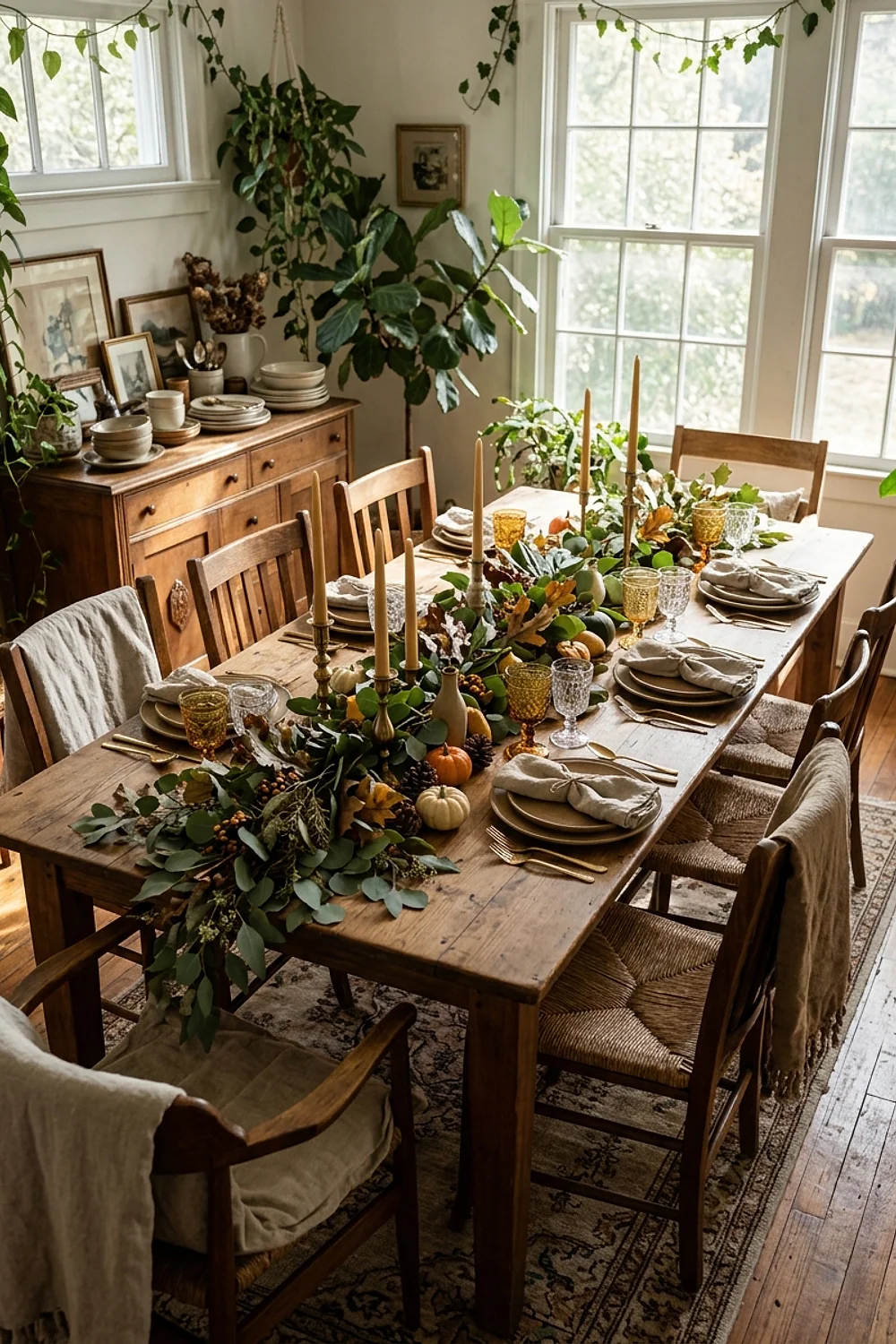
18 Thanksgiving Decorations Table Ideas That Look Expensive
How do you fill a six-foot table so it looks styled instead of stacked, without a $400 trip to a home store? A thanksgiving decorations table that photographs well usually runs on repetition, a tight palette, and a few thrifted pieces, not a cart full of seasonal-aisle impulse buys.
Below are 18 specific moves, with measurements, materials, and costs where cost matters. Most take an afternoon, and several use things already in a closet.
Why a thanksgiving decorations table doesn’t have to break the bank
The expensive-looking tables share three traits: a limited palette, varied heights, and nothing crowding the plates. None of those cost money. They cost planning.
A standard 72 x 36 inch table gives each guest about 24 inches of length. Whatever decor goes down the middle has to live inside a strip roughly 10-12 inches wide, or it fights the place settings. Keep that number in mind, because every idea below gets tested against it.
A kraft paper runner
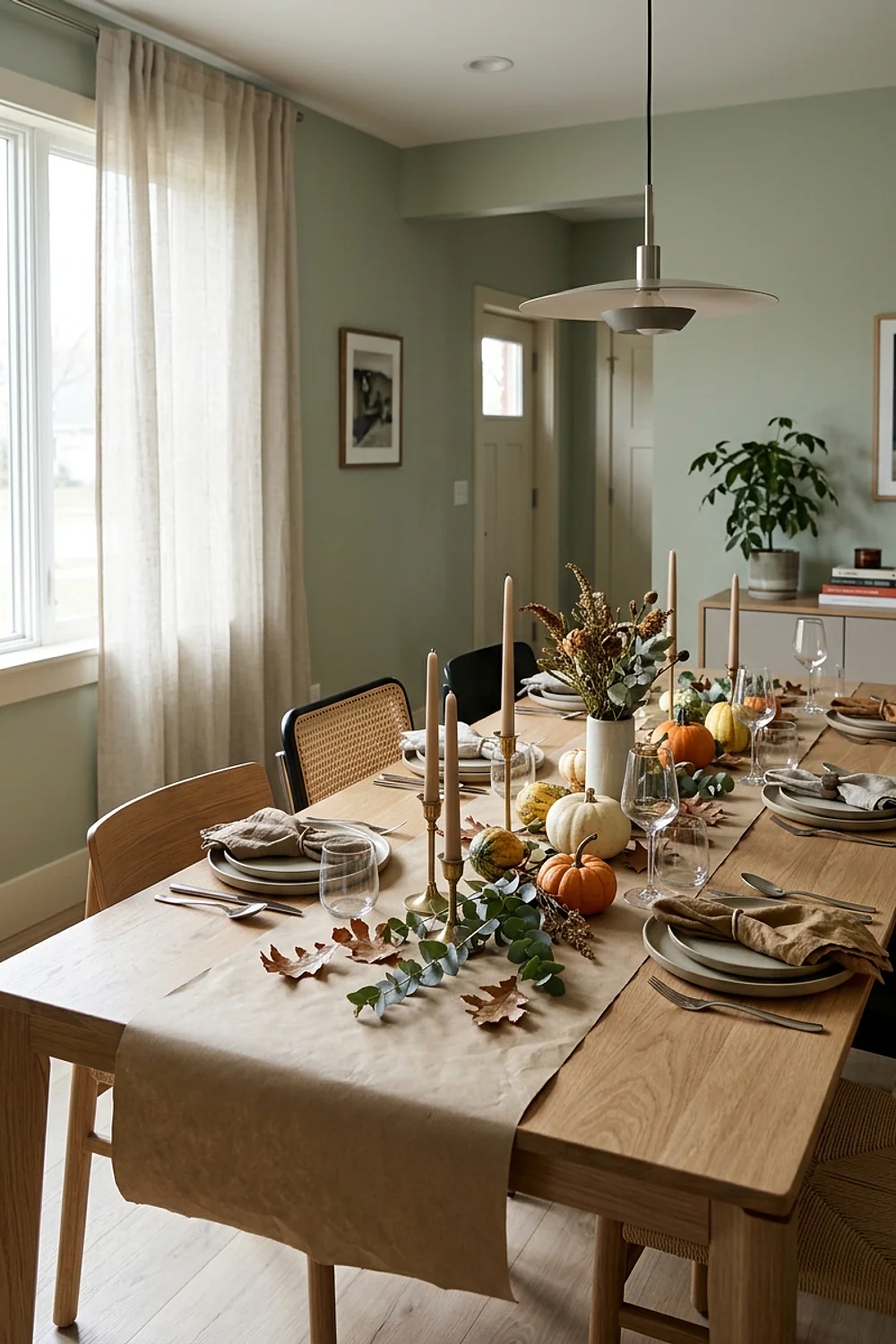
A 30-foot roll of kraft paper costs about $8 and unrolls into a runner that hides scratches and ring marks. The roll stores upright in a corner or inside a cardboard tube, so there’s no folding and no creases to steam out later.
Cut it 16 inches wide and let it drape 6 inches past each end. This suits casual tables and big family crowds, where a spilled glass of cider means you simply tear the sheet off. Skip open flame directly on the paper, though, and set tapers in glass holders.
Mismatched thrifted candlesticks
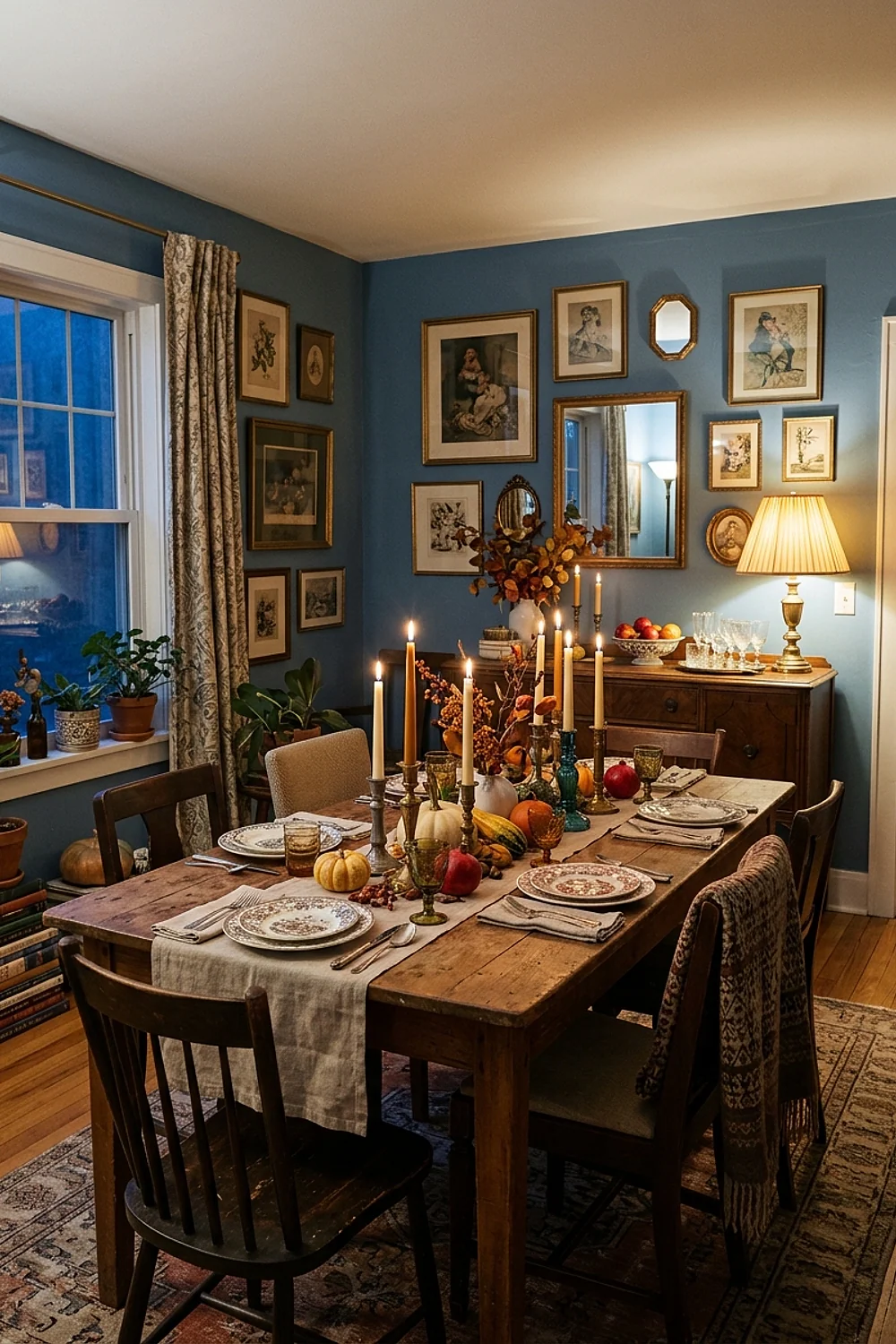
Three to five candlesticks in brass, turned wood, or milk glass look intentional when the heights step up in clear increments, such as 6, 9, and 12 inches. Matching finishes matter less than matching tones, so keep everything in one warm family.
Thrift shops and estate sales are the source here. On a 72-inch table, stop at five. A sixth piece starts to read as clutter.
Napkins cut from fabric yardage
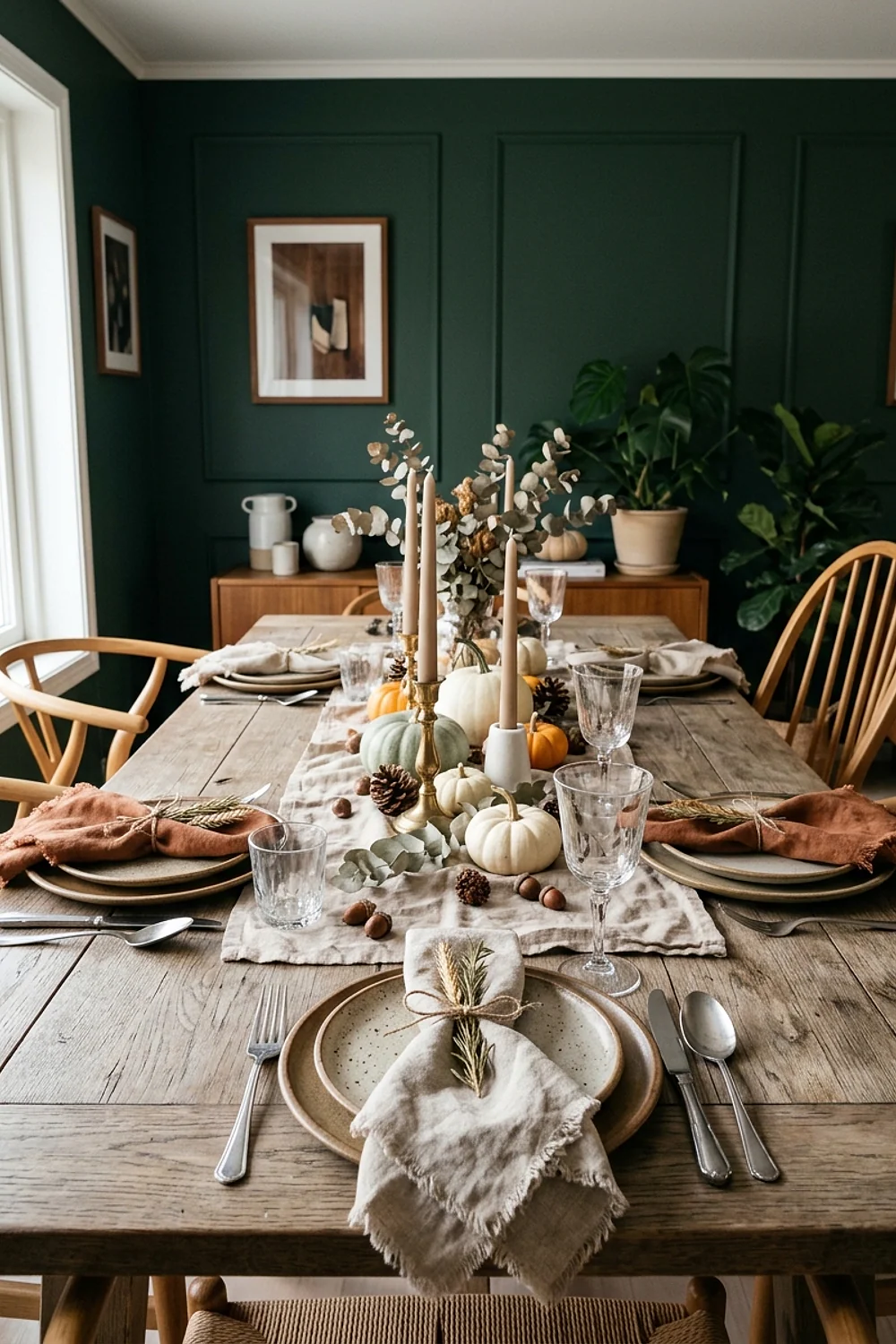
A yard of linen blend at roughly $5 cuts six 18-inch napkins from a 54-inch-wide bolt. That works out to under a dollar each, and the weight feels far better in the hand than paper.
Wash and dry the fabric first, because linen shrinks 3-5 percent. Hem tape is fine for beginners. Raw pinked edges fray after one wash, so they only suit a single-use table.
A rust, ochre, and olive palette
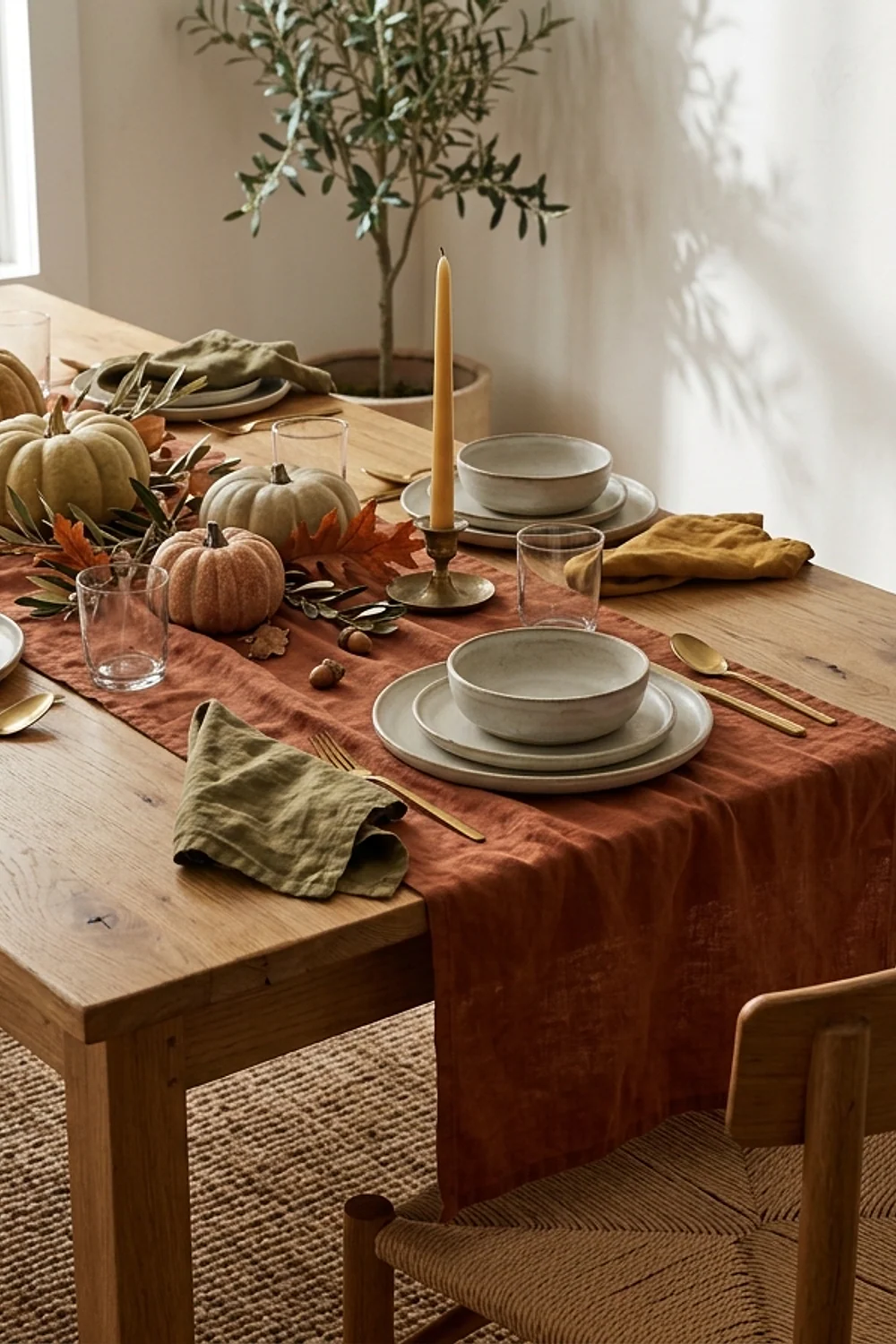
Pick three colors plus cream, then hold the ratio near 60 percent cream, 30 percent one main color, and 10 percent the other two. A muted terracotta such as Sherwin-Williams Cavern Clay is a good anchor, with olive and mustard in small doses.
Late-afternoon light pushes orange tones deeper, and olive can go muddy under yellow bulbs. Bright pumpkin orange is the common trap, because it fights every other color on the table.
Building the middle of a thanksgiving decorations table
The center of a thanksgiving decorations table is where most budgets leak. Ten small purchases look worse than four deliberate ones, and these next four ideas show why.
A centered spine, not scattered accents
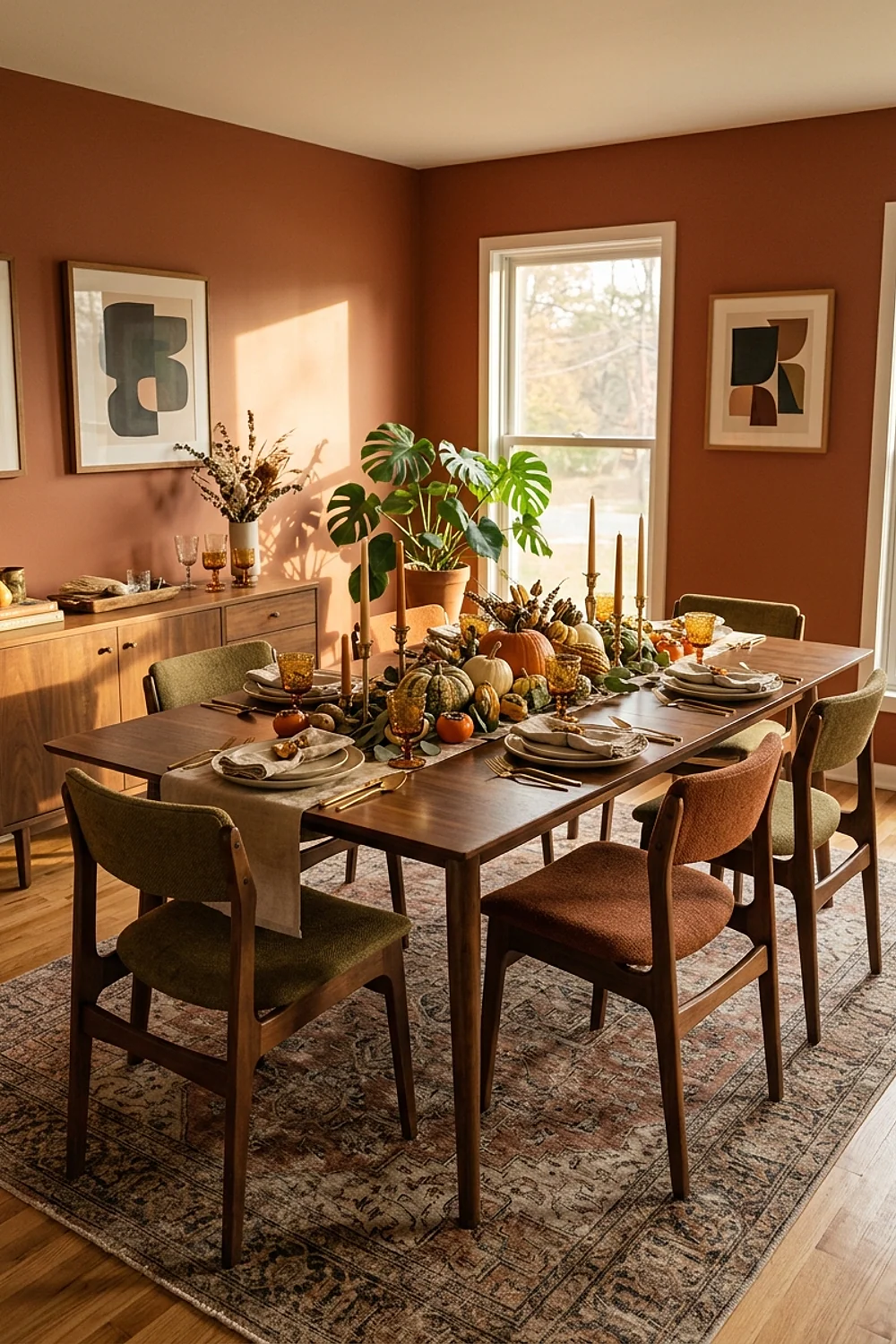
Line the candlesticks, gourds, and bud vases along the table’s centerline in one continuous strip, 10-12 inches wide. It reads as a single composition, which makes cheap pieces look planned.
Leave about 8 inches of clear tabletop between clusters so platters can still land. This suits long rectangular tables best. On a round table, shrink the spine into a single 14-inch cluster.
Tall branches over mid-height arrangements
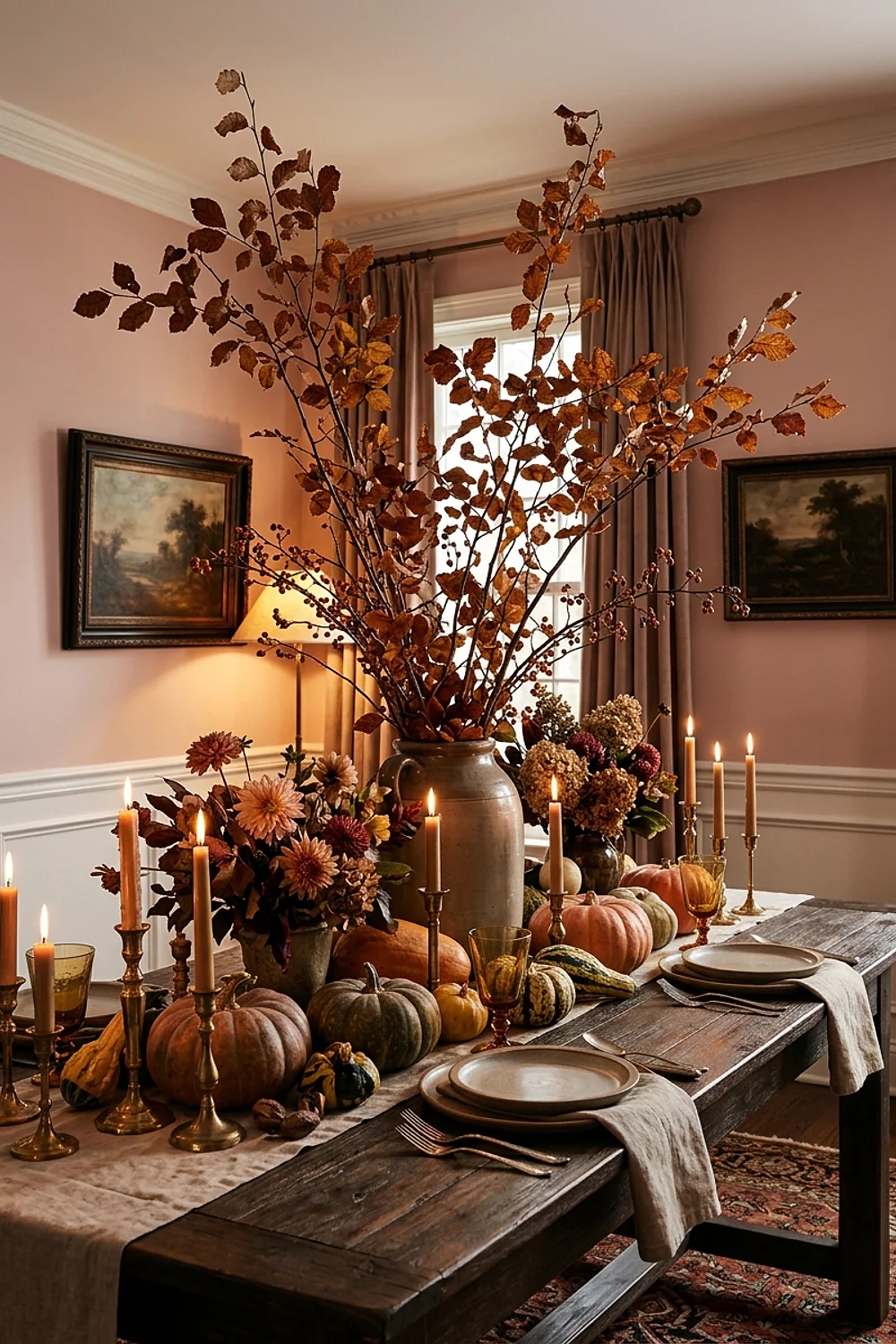
Conventional advice says keep centerpieces under 12 inches so guests can see each other. That rule misses the real problem. Seated eye level sits about 14-16 inches above the tabletop, so the blocking zone is 14-24 inches of dense foliage.
Bare branches such as forsythia, bittersweet, or birch, standing 30-36 inches tall in a heavy vase, let sightlines pass underneath. Strip the lower 18 inches of leaves. Foraged stems cost nothing, and a weighted vase stops tipping.
Real pumpkins and gourds in clusters of three
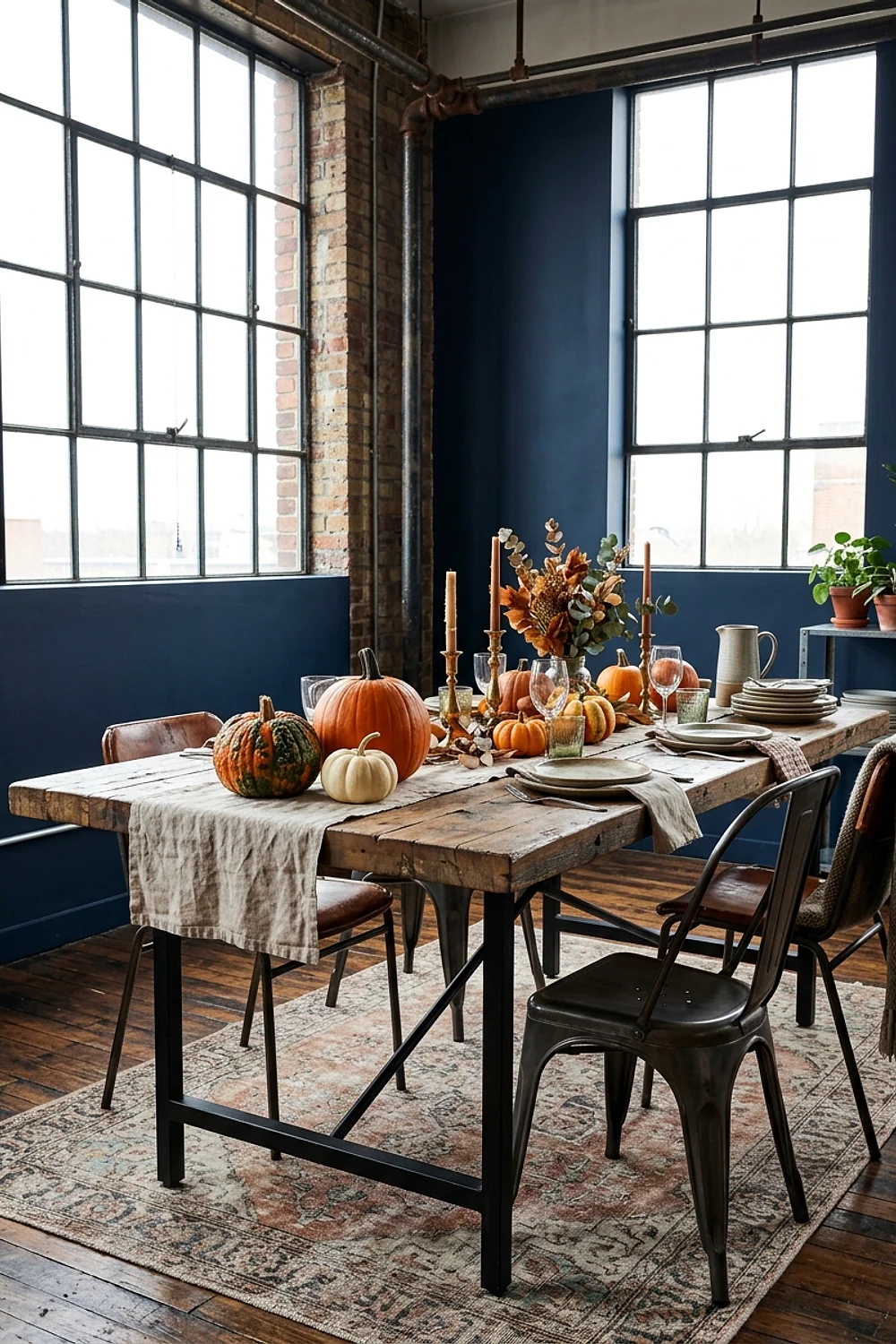
Cinderella pumpkins run $3-$6 each, and an uncut one lasts two to three months, so buying in early October is fine. That’s the counterintuitive part: real produce outlasts most faux arrangements in a damp house.
Vary sizes between 6 and 12 inches and set the cluster on a felt pad or saucer. Wet stems leave rings on wood. If the table is a family heirloom, those rings are permanent.
Chargers sized to the plate
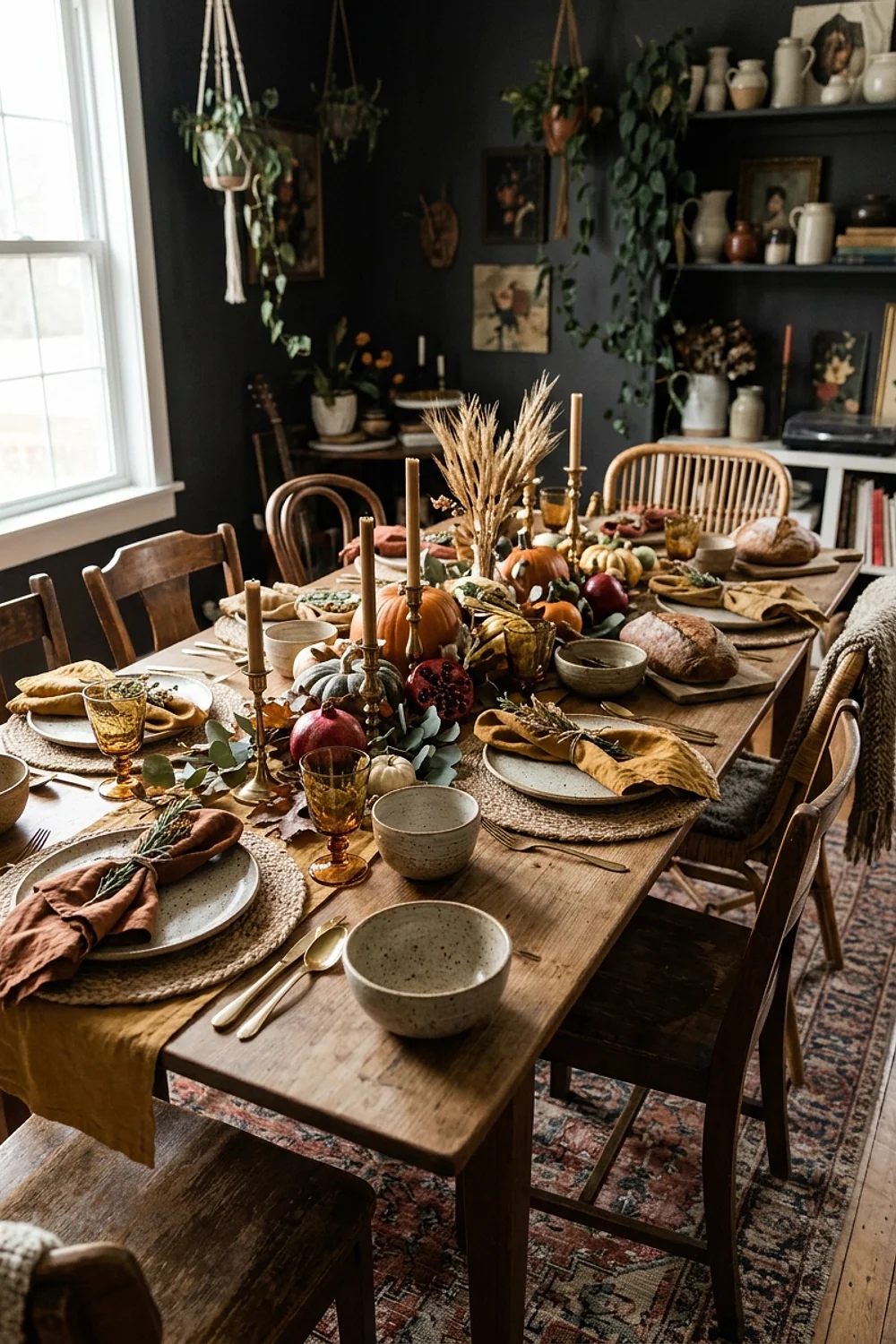
A 12-13 inch charger under a 10.5-inch dinner plate leaves a rim of about 1 inch, just enough to frame the plate without crowding it. Rattan and wood work well because they add texture without competing with the plate, and they hide small drips between courses.
Chargers suit a table of 72 inches or longer, where each setting still gets room. Wider chargers eat the width a 36-inch table needs for glasses and cutlery. On a 60-inch table, skip them entirely.
Things that elevate the room
These four ideas cover what guests touch and see for the two hours or more a Thanksgiving dinner runs.
Taper candles in glass holders
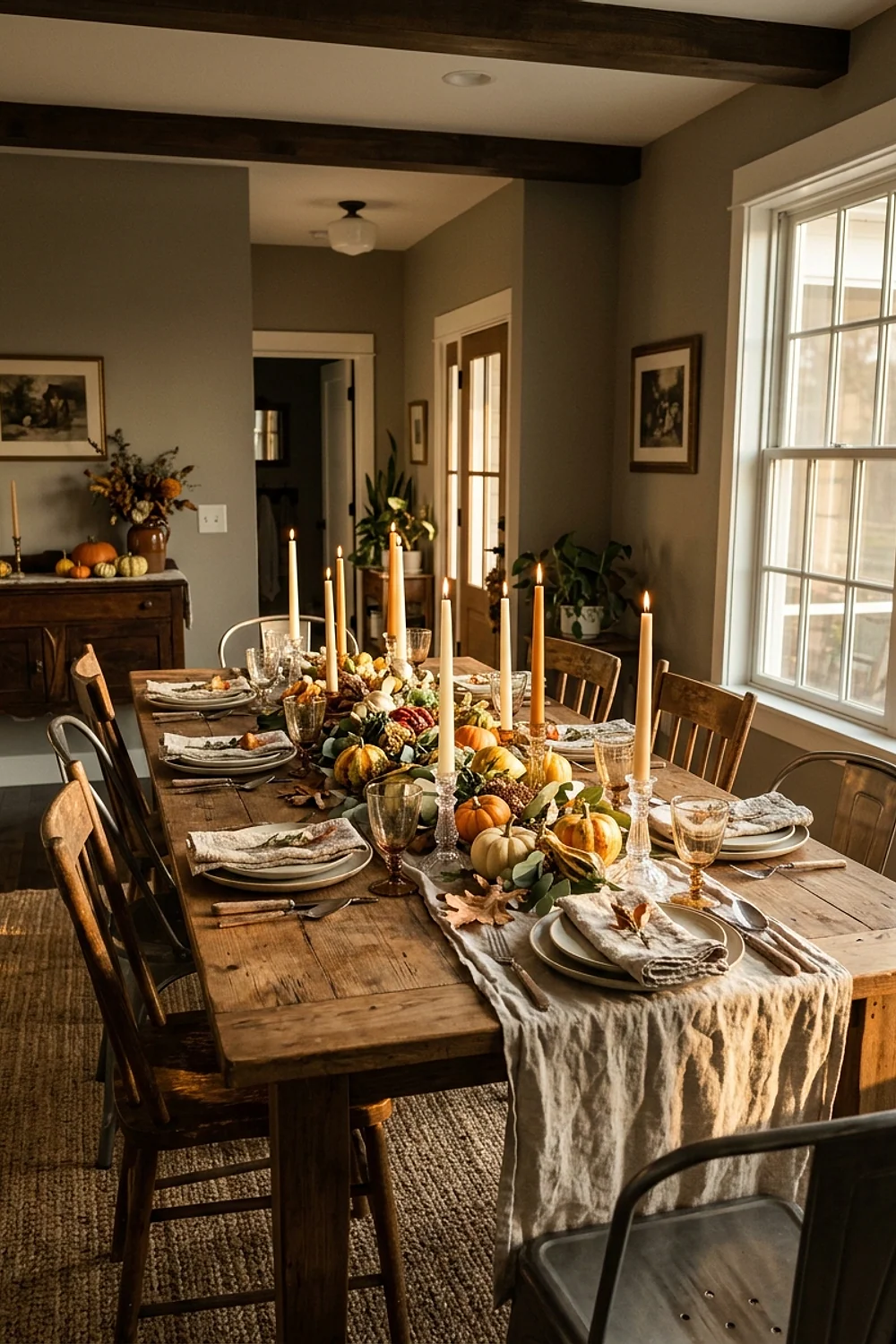
A 12-pack of 10-inch tapers costs about $9, and each burns roughly seven hours. During a gray November afternoon, daylight fades by 4:30, so flames start earning their keep before the food hits the table.
Set the flame above or well below face height, never at it. A 10-inch taper in a 3-inch holder lands the flame right at eye level, so use 12-inch tapers or short votives instead.
Seat pads and a wool blanket on the bench
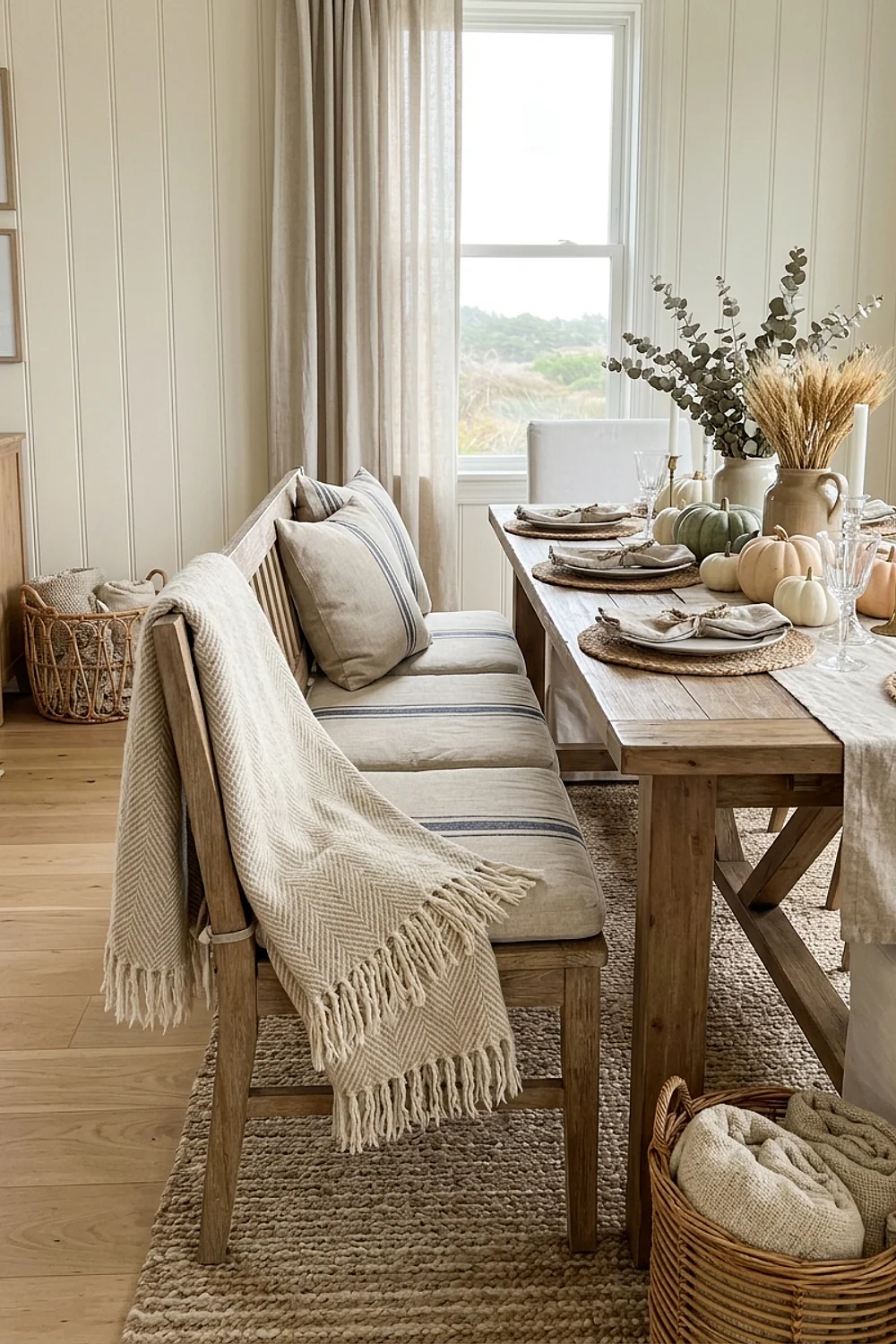
Two-inch foam pads in 16-inch squares, tied to the chair back, turn hard seats tolerable for a long sit. The foam spreads pressure away from the sit bones. A folded wool blanket over a bench does the same job and doubles as texture, which suits a rustic table where a bench seats extra guests.
This matters most for hosts with folding chairs, which are the worst offenders after 45 minutes. Slippery pads migrate, so add a non-slip liner underneath, or guests will spend dinner nudging cushions back into place.
Dried wheat and hydrangea in bud vases
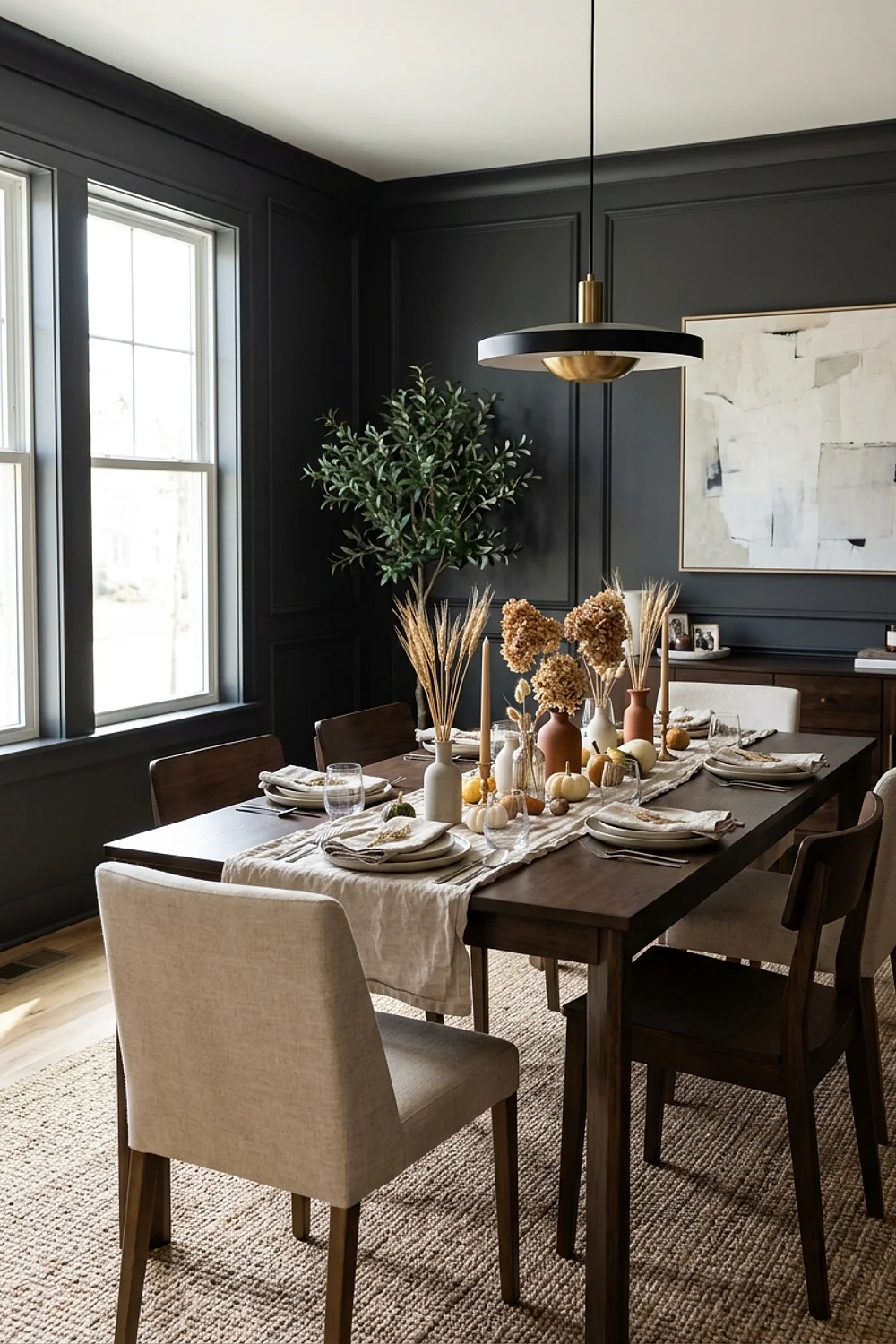
Grocery-store wheat bundles trimmed to 8-10 inches fit in small bud vases and look good beside pumpkins. Store them in a shoebox with tissue, and they come back out year after year.
Dried stems shed, so keep them away from the serving zone. They suit anyone who wants a decoration that doesn’t wilt on the table before dessert is even cut.
Leaf place cards written with a paint pen
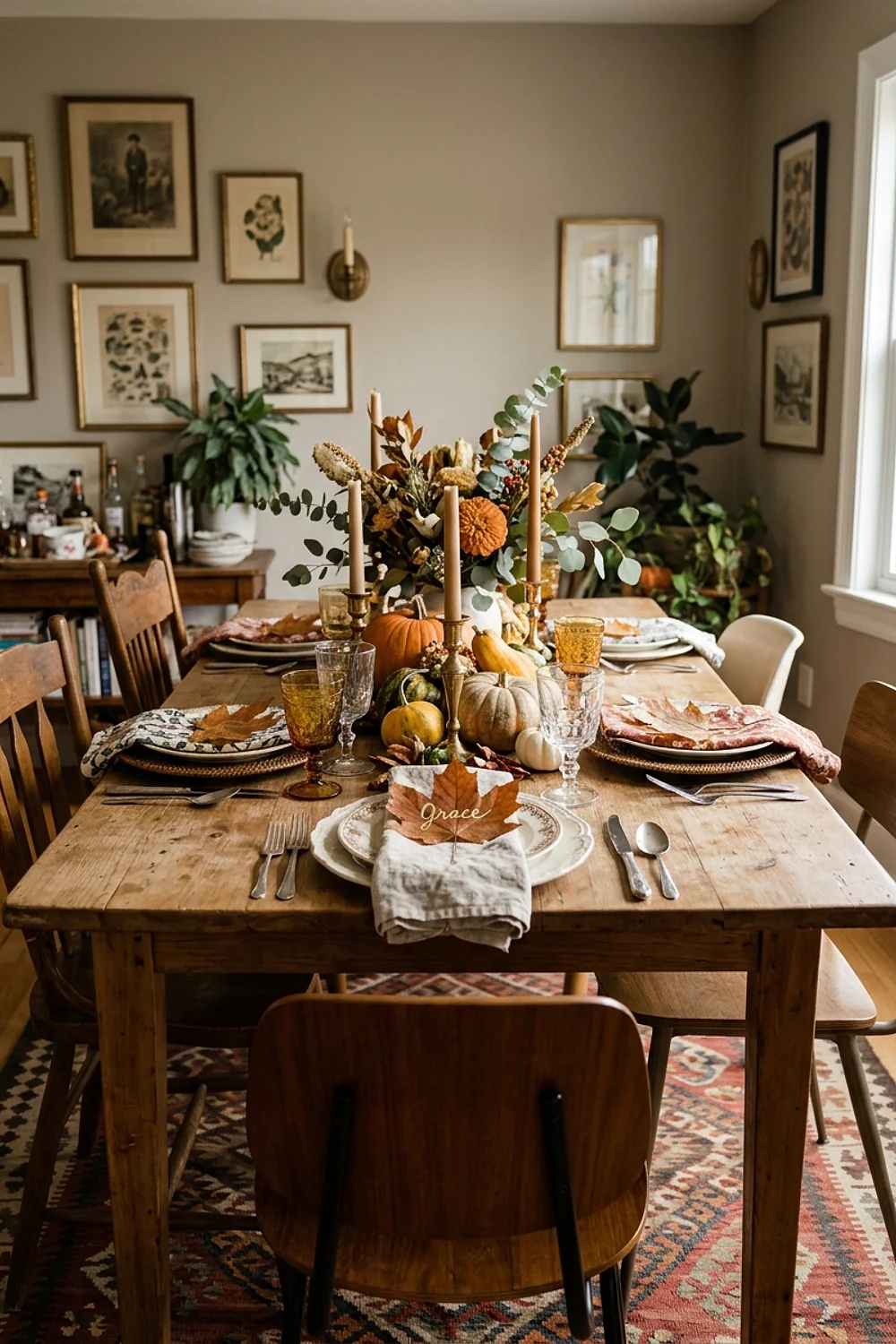
Magnolia leaves hold flat for two to three days, while oak leaves curl within 24 hours. Write names with a 0.7 mm white paint pen the day before and keep the leaves between paper towels.
Each leaf takes under a minute, and a 12-person table is done in one sitting. Test the pen on a spare leaf first, since oily magnolia surfaces can smear when rushed.
Trays, baskets, and side surfaces
Stuff that has to sit on the table gets a plan too, and these three ideas keep the clutter organized.
A thrifted wooden tray to corral small things
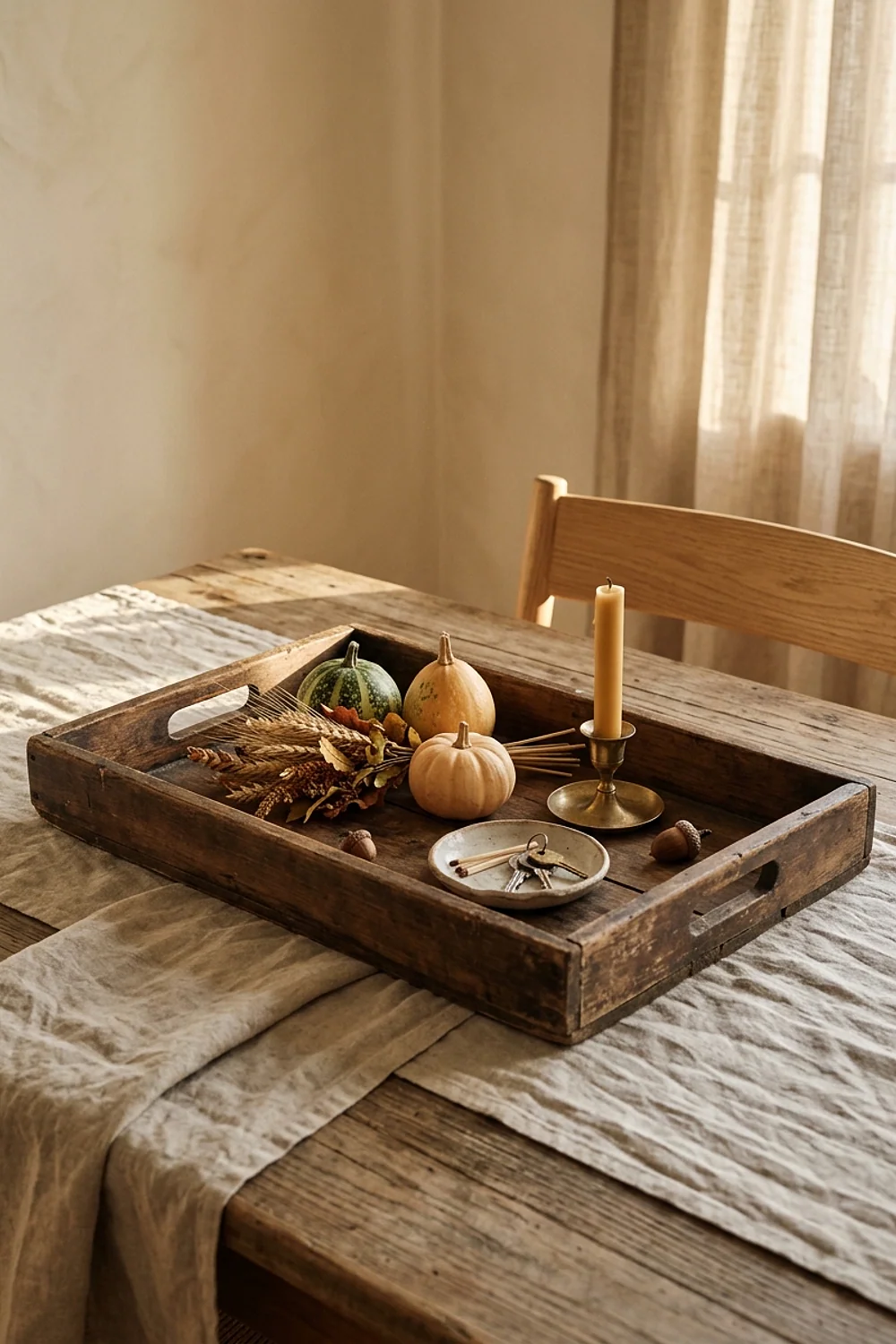
A 14-inch round tray, about $6-$10 secondhand, holds salt, pepper, butter, and a gravy boat in one footprint. That keeps stray ring marks off the wood and the center spine tidy.
Look for a lip of at least an inch so nothing slides. It works best on tables with a solid center strip, and less well on round tables, where the tray crowds the middle.
White ironstone against a dark cloth
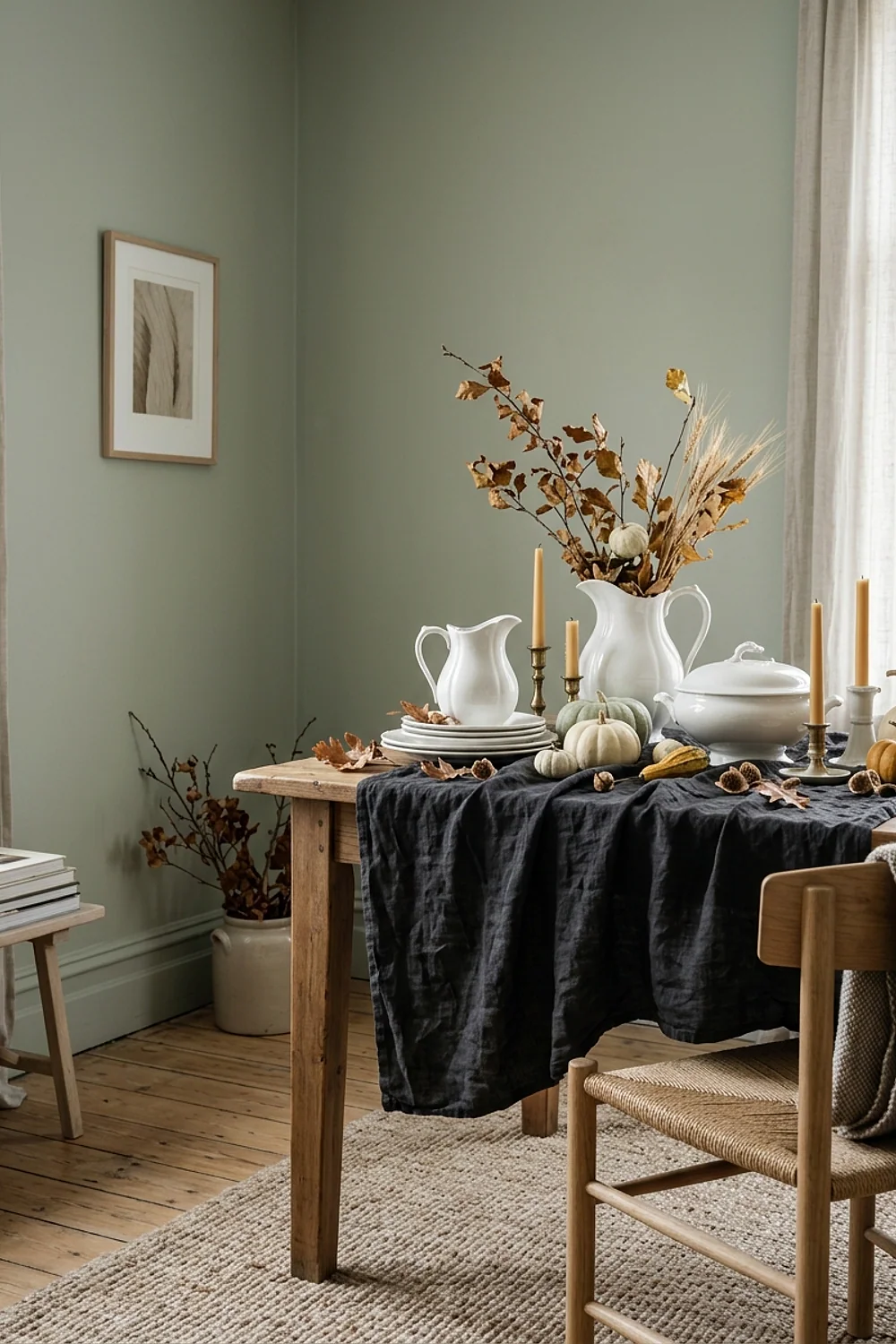
Plain cream or white ironstone plates look sharp against a charcoal or forest green tablecloth. The contrast makes the table feel finished without a single extra object, because the pale rims read clearly against the dark ground.
This suits hosts on a tight budget or with a mix of inherited and thrifted plates. Mismatched ironstone is fine, since the glaze tones stay close. If the table is already dark wood, skip the dark cloth and let the wood do the work; layering dark on dark flattens the plates.
A sideboard vignette built in a triangle
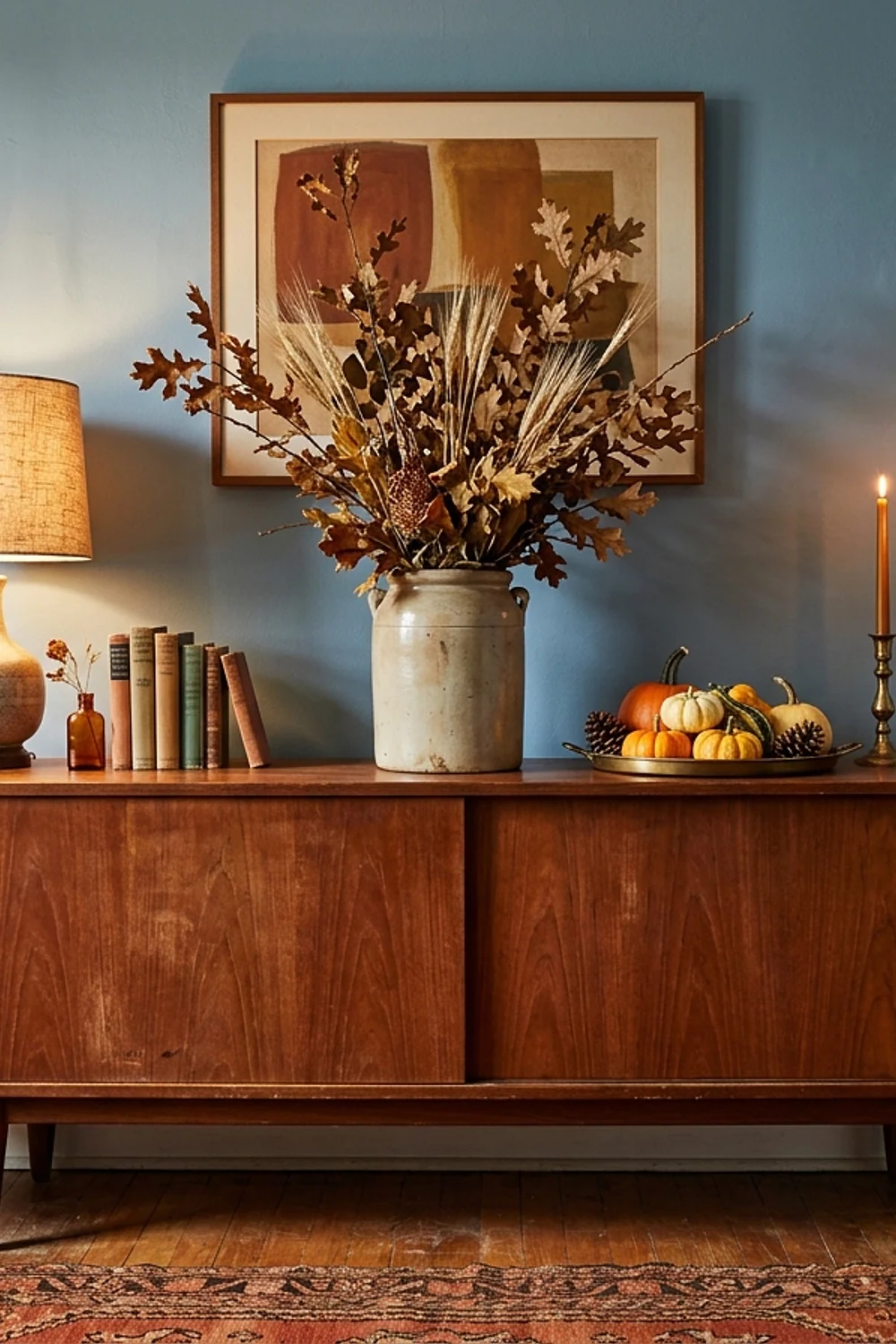
A sideboard 14-18 inches deep takes a three-part arrangement: a $12 thrifted lamp with a 10-inch shade as the tallest piece, a bowl of gourds in the middle, and a short stack of plates at the edge. Keep the tallest item near 24 inches.
The lamp matters most. At 4pm in November, a shaded bulb spreads a warm pool that makes the whole room feel finished before a single candle lights.
Styling tips
The last three items cover the usual ways a good table goes wrong.
Unscented candles only at the table
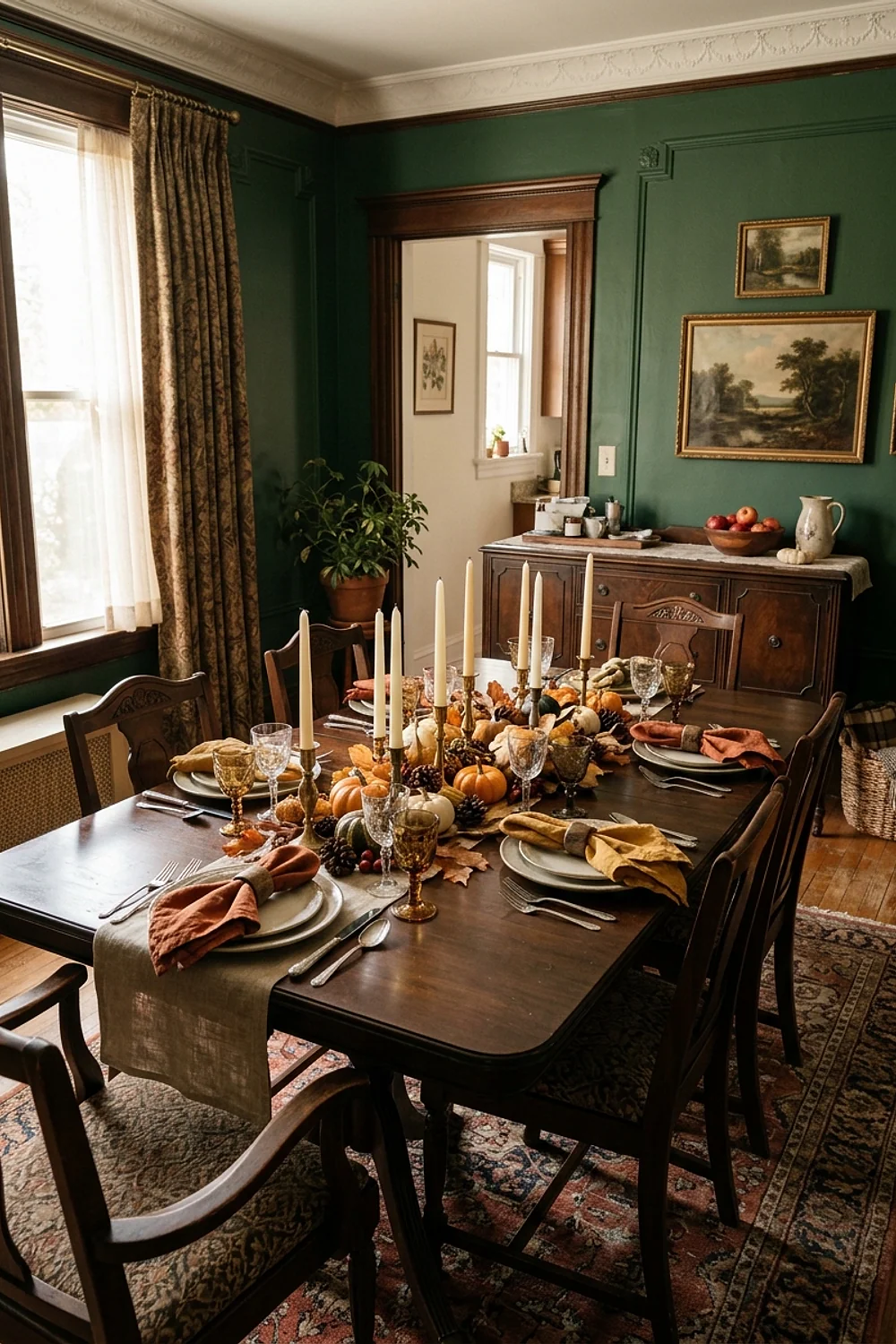
A cinnamon-apple candle burning two feet from the gravy fights every smell on the table. Unscented tapers keep the aroma where it belongs, on the turkey, the sage stuffing, and the pies, so guests can actually taste what they eat.
If scent is non-negotiable, one candle in the entry hall does the job and suits a small home where the kitchen smells already carry. The mistake is common because seasonal candles are the first thing in every store aisle, so check labels before buying, since even “lightly scented” tapers add up.
Brass spray paint on dollar-store holders
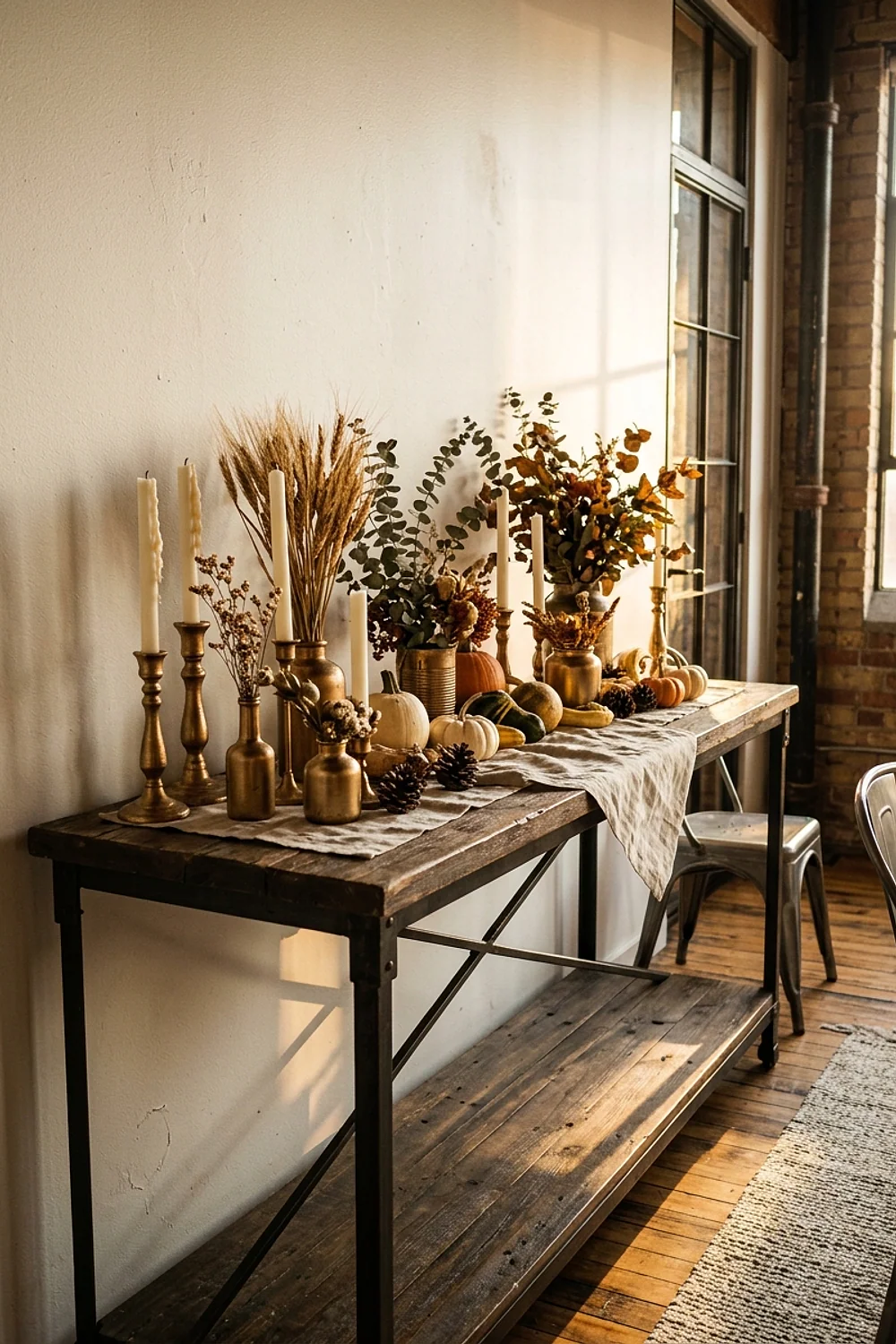
A $7 can of metallic spray paint turns plain glass or ceramic holders into passable brass. Sand lightly, apply two thin coats 15 minutes apart, and let them cure a full 24 hours.
The paint isn’t food-safe, so keep it on candle holders and vases only. Thick single coats drip and look cheap, which is exactly the problem this trick is meant to avoid.
Decor scaled to the table’s length
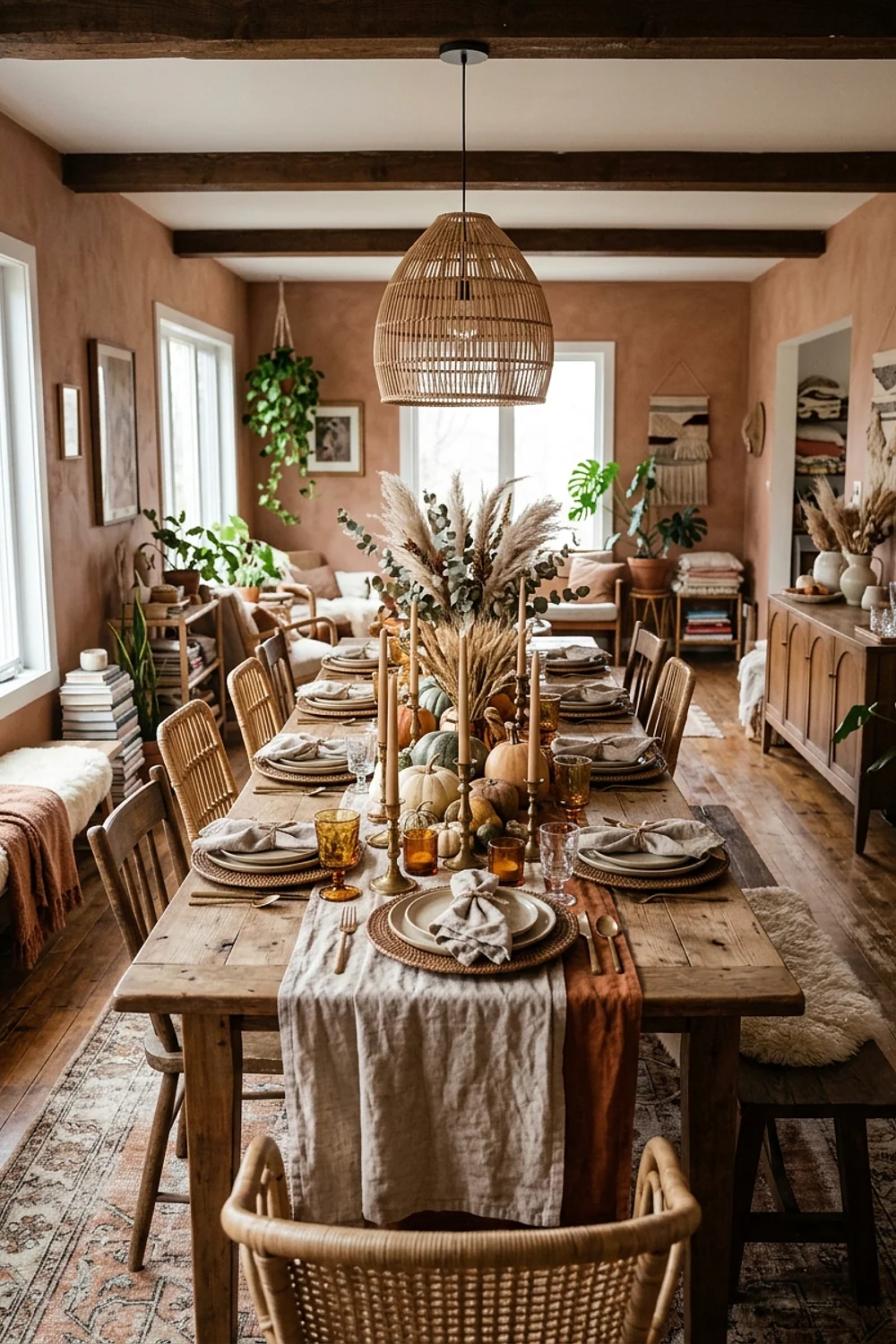
Aim for five objects along a 6-foot spine and seven along an 8-foot one, always odd numbers. Keep about 30 percent of the tabletop bare, because platters need somewhere to land.
Crowding is the dominant failure on small tables, and it’s easy to miss until the first bowl arrives with nowhere to go. Remove one item before guests sit, and the table almost always improves.
Shopping guide
The best pieces for a thanksgiving decorations table rarely come from the seasonal aisle at full price. These are the sources worth checking, in order:
- Thrift stores for candlesticks, trays, and ironstone, where single pieces often run $1 to $3.
- Estate sales on the final day, when remaining stock is marked down.
- Post-Halloween clearance on November 1, for orange-free fall accents.
- Grocery produce sections for pumpkins, gourds, wheat, and magnolia branches.
- Facebook Marketplace for table linens and chargers sold in bulk.
Go early in the week. Thrift shops restock Monday and Tuesday, and the good brass is gone by Saturday.
DIY vs store-bought: honest comparison
A thanksgiving decorations table mixes handmade and bought pieces best when each is used where it earns its keep. Here’s how the two compare:
- Runners: a DIY fabric runner costs about $12, while store-bought linen runs far more and looks nearly identical at arm’s length.
- Candle holders: spray-painted thrift finds match bought brass from three feet away, but not up close.
- Napkins: sewn yardage beats paper in feel, though store-bought sets save time and hem more evenly.
- Place cards: handwritten leaves look better than any printed card.
The rule that holds up: make what guests touch, and buy what they see from across the room. It’s not foolproof. But it works.
The pieces that earn their place
Measurements prevent more waste than any coupon, because a piece that’s too big for the table is money spent twice. Check these before leaving the house:
- Table length and width, to set the spine at 10-12 inches wide.
- Plate diameter, to confirm chargers leave a 1-inch rim.
- Sideboard depth, so the lamp and bowl don’t overhang.
- Tall vase height, keeping branches near 30-36 inches.
Write the numbers on a phone note and keep it open while shopping. A 3-inch miss on a vase is easy to make under store lighting.
Your thanksgiving decorations table game plan
A good thanksgiving decorations table comes down to a three-color palette, a 10-12 inch spine, and pieces at several heights. Everything else is optional, and most of it can be thrifted or made for very little.
Save or pin this list so it’s handy when the shopping starts. Begin by measuring the table and cutting the kraft paper runner, since every other piece builds on that strip.


